
Osteoarthritis – Chiropractic care in Montreal
Relieve osteoarthritis and support joint mobility through a targeted postural approach
Joint pain that sets in, morning stiffness, a loss of range in the neck or lower back: osteoarthritis is one of the most frequent joint diseases in Canada, and its risk increases with age. This chronic, degenerative joint disease is characterized by progressive cartilage wear and local inflammation. Dr. Hamza Beghdadi, chiropractor in Montreal, offers a chiropractic approach to osteoarthritis, structured to relieve joint pain, help slow the progression of osteoarthritis, and support joint mobility. The care for osteoarthritis relies on the CBP technique, on objective rather than subjective measurements, and on a clear care plan presented before treatment.
Discuss your osteoarthritis at a first chiropractic evaluation
Book an appointment
Why consult Dr. Hamza Beghdadi, chiropractor, for your osteoarthritis care
Here is what characterizes the practice of Dr. Beghdadi, chiropractor, for the care of osteoarthritis:
- Training in the CBP technique, for chiropractic care of osteoarthritis grounded in objective postural measurements.
- Doctor of Chiropractic from UQTR and more than ten years of practice serving Montreal patients.
- Bachelor's degree in biochemistry from the Université de Montréal, for a solid scientific background.
- Complete evaluation at the first visit: history, orthopedic tests, neurological tests, palpation, postural analysis, X-ray if needed.
- Care plan explained before adjustments begin.
- A constant focus on prevention, ergonomics, and patient education.
- Two chiropractic clinics: Roxboro (West Island) and Villeray.
The CBP technique in the service of your osteoarthritis: objective measurements and a care plan
The Chiropractic BioPhysics (CBP) technique is a protocol of postural correction built on objective measurements of the physiological curves. For osteoarthritis, this matters in particular: a joint that bears poorly distributed loads wears down faster. By restoring better alignment, the care plan aims to slow the degeneration, support joint mobility, improve quality of life, and preserve function day to day.
Plan a consultation with a chiropractor trained in the CBP technique in Montreal
The right protocol begins with the right chiropractic evaluation. Book a consultation to assess whether the CBP approach suits your osteoarthritis.
Book an appointmentWhat is osteoarthritis? Understanding joint degeneration
Osteoarthritis is a chronic degenerative process characterized by the breakdown of the cartilage of the joints, accompanied by a local inflammatory component. It is not a simple inevitability of aging, but a multifactorial mechanical condition where cartilage wear, abnormal loads, inflammation, and postural imbalances interact over the years.
Cartilage, joint, and the mechanism of arthritic pain
Cartilage covers the ends of the bones and allows the joint surfaces to glide without friction. When it thins, the bone comes into more abrupt contact with the adjacent bone, and inflammation sets in progressively.
This local inflammation is the main source of the arthritic pain felt day to day. As the cartilage breakdown progresses, osteophytes (bone spurs) appear at the edges of the degenerating joints, and the range of motion narrows. Stiffness and limited movement add to the joint pain.
The types of osteoarthritis: spinal, peripheral, and facet
Three broad families of osteoarthritis are distinguished according to the structures affected:
- Spinal osteoarthritis: affects the spine, at the cervical or lumbar level, with breakdown of the intervertebral discs and the vertebral endplates.
- Peripheral osteoarthritis: concerns the joints of the limbs, mainly the knee (gonarthrosis), the hip, and the shoulder.
- Facet osteoarthritis: a form of spinal osteoarthritis that specifically affects the posterior facet joints of the spine.
All share one thing in common: posture and the distribution of loads directly influence their progression.
Symptoms, causes, and risk factors of osteoarthritis
Osteoarthritis sets in slowly, often without being noticed. The first signs pass for passing stiffness or intermittent joint pain, and it is their persistence that eventually reveals the underlying degenerative condition.
Common manifestations according to the joint affected
The symptoms of osteoarthritis vary according to the joint, but a few manifestations come up almost every time:
- Joint pain that worsens with effort and calms with rest.
- Morning stiffness that generally lasts less than thirty minutes.
- Limited movement and loss of range of motion.
- A sensation of cracking or rubbing on joint movement.
- Intermittent swelling of the joint and local inflammation.
- Muscle weakness around the affected area.
- Numbness when osteoarthritis compresses an adjacent nerve.
The intensity of the symptoms does not always reflect the extent of the degeneration visible on imaging.
Causes and risk factors to know
Osteoarthritis rarely results from a single event. Several factors interact, some modifiable and some not:
- Aging and natural wear: over the years, cartilage loses elasticity, hydration, and capacity to regenerate.
- Established poor posture: remote work, screens, and a sedentary lifestyle create postural imbalances that overload certain joints. Several articles detail the importance of good posture.
- Old trauma: falls, accidents, and poorly healed sprains can generate post-traumatic osteoarthritis years later. See our article on old trauma and post-traumatic osteoarthritis.
- Repeated loads and movements: certain occupations or sports create repeated strain on specific joints.
- Excess weight: each kilo adds not one but several kilos of pressure on the knees with every step, accelerating the cartilage breakdown.
- Genetics and heredity: some people develop familial osteoarthritis earlier.
- Sedentary lifestyle: the less a joint moves, the less it is lubricated and nourished.
Posture occupies a central place in this list of factors. A postural imbalance redistributes loads onto structures that were not designed to bear them, and that is precisely the mechanism targeted by postural correction with the CBP technique, to slow the progression and help prevent recurrence.
Do your symptoms resemble those of osteoarthritis? Book an evaluation
Recognizing your symptoms is the first step toward pain relief. A complete chiropractic evaluation helps clarify what is happening and identify the care options suited to your osteoarthritis.
Book an appointment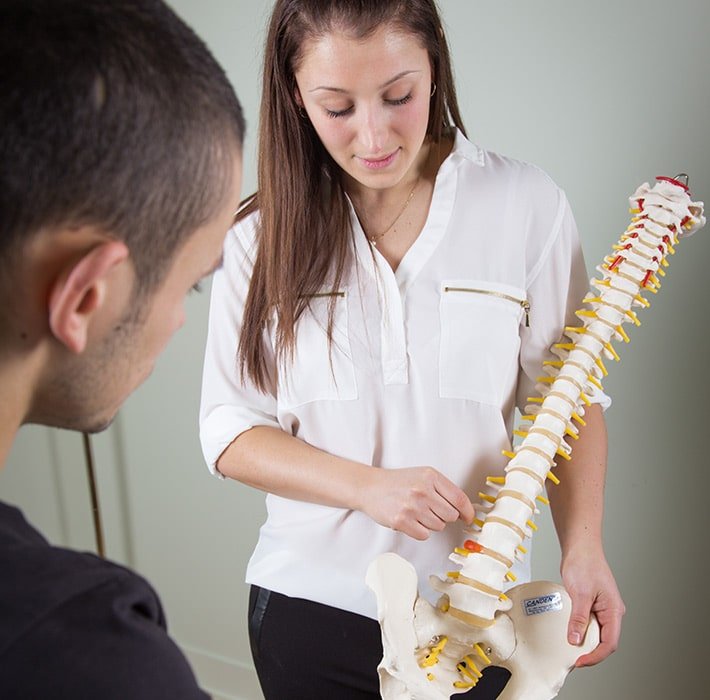
Spinal osteoarthritis: cervical, lumbar, and facet
Osteoarthritis of the spine is one of the areas where the postural approach has the most to offer. The spine bears considerable loads day to day, and the slightest misalignment repeated over years eventually marks the joint and disc structures.
Cervical osteoarthritis and its impact on head posture
Cervical osteoarthritis affects the vertebrae of the neck and their intervertebral discs. It is often associated with a forward head posture, that position where the head juts forward because of screens.
The further the head juts forward, the more the load felt by the cervical spine increases. Biomechanical studies on head position show that a tilt of 15 degrees can more than double the load on the cervical vertebrae. The cervical lordosis flattens, the physiological curves disappear, and the strain on the cervical joints climbs. Typical symptoms include chronic neck pain, headaches of cervical origin, and morning stiffness.
Lumbar osteoarthritis and nerve-root compression
Lumbar osteoarthritis concerns the L1 to L5 vertebrae and the sacrum. It presents as chronic low back pain, morning stiffness, and joint pain aggravated by prolonged standing.
Over time, the wear reduces disc height and narrows the intervertebral foramina through which the nerve roots exit. This compression can generate pain radiating into the legs, sometimes indistinguishable from sciatica and compression of the sciatic nerve. Lumbar osteoarthritis also favours the onset of a lumbar or cervical herniated disc, since the loss of disc height changes the mechanics of the segment.
Facet osteoarthritis and facet syndrome
Facet osteoarthritis affects the facet joints, those small posterior joints that ensure the stability of the spine. When they wear down, this is called facet syndrome.
The pain is typically well localized near the spine, worsens in extension and rotation, and can radiate into the buttock. It is one of the most frequent and least diagnosed causes of chronic low back pain in adults over forty. A precise postural evaluation makes it possible to identify the overloaded segments.
Our chiropractic approach to osteoarthritis treatment
The chiropractic approach to osteoarthritis treatment does not seek to erase the wear, but to change the mechanics that sustain it. If the same joints keep being subjected to unbalanced loads, osteoarthritis progresses and the degeneration accelerates. If a more functional alignment is restored, the pressure is redistributed, the breakdown may slow, and quality of life improves. The article chiropractic care can relieve back pain develops this logic.
Complete chiropractic evaluation at the first visit
Every care plan begins with a complete chiropractic evaluation at the first visit. The history retraces the story of the joint pain, the medical background, and the lifestyle. The orthopedic and neurological tests make it possible to assess and to differentiate osteoarthritis from other conditions, such as bursitis. Palpation locates the segments in restriction, and the postural analysis measures the deviations that overload certain joints. At the end, Dr. Beghdadi, chiropractor, establishes a clear chiropractic diagnosis.
-
-
Personalized care plan using the CBP technique
The care plan is presented at the second visit, after a complete analysis of the data gathered. It relies on the CBP technique and combines several modalities to relieve symptoms and support joint mobility:
- Targeted chiropractic adjustments following the Mirror Image® principle, which repositions the structures toward a healthier alignment.
- Corrective spinal traction to act on the ligaments, the tendons, and the durability of the correction.
- Personalized postural exercises, at the clinic and at home, to reinforce the new posture.
- Ergonomic advice adapted to your work and your daily life.
- Progress tracking with objective control measurements.
Day-to-day prevention always complements the care plan. A healthy weight, suitable physical activity, muscle-strengthening exercises, and 5 ways to improve your posture amplify the benefits of the chiropractic sessions and contribute to preventing recurrence.
When osteoarthritis is very advanced
When osteoarthritis reaches an advanced stage, certain common chiropractic procedures may not be indicated. Dr. Beghdadi, chiropractor, then assesses what is safe, adjusts the approach, or refers to another professional when it is in the patient's interest.
A conservative approach can continue to bring pain relief even in advanced cases, by working on the adjacent segments and overall posture. The goal remains improving mobility, reducing inflammation, and improving quality of life.
Get a personalized care plan for your osteoarthritis
Book an appointmentFrequently asked questions about osteoarthritis treatment
How do you relieve osteoarthritis day to day?
Several measures help relieve osteoarthritis day to day and prevent worsening. Maintaining regular physical activity preserves joint lubrication and muscle strength. Caring for your posture and ergonomics reduces mechanical strain. A modest weight loss is often enough to lessen the pressure on the knees and reduce local inflammation. These measures are more effective when they fit into a structured care plan that aims to slow the degeneration.
What should you do for osteoarthritis that is setting in?
The first step is to evaluate the precise mechanical cause, not to mask the joint pain. A complete chiropractic evaluation determines which joints are overloaded and which postural factors sustain the degenerative condition. From there, a care plan can combine adjustments, muscle-strengthening exercises, and ergonomic advice to slow the progression and support joint mobility.
How many chiropractic sessions to relieve osteoarthritis?
The number of chiropractic sessions varies according to how long the osteoarthritis has been present, its stage, the joint affected, and the response to care. An active phase of a few weeks aims to initiate pain relief and postural correction. A stabilization phase follows, with more spaced-out sessions to support quality of life. The care plan is presented with a clear estimate before treatment.
Is chiropractic safe in cases of severe osteoarthritis?
In severe or advanced-stage osteoarthritis, the usual chiropractic adjustments are not always indicated. That is why the initial chiropractic evaluation is so important: it makes it possible to adapt the approach, to favour gentler techniques such as joint mobilizations, or to refer to another professional if needed. Patient safety is always paramount.
When should you consult a chiropractor for osteoarthritis?
It is worth consulting as soon as the joint pain becomes recurrent, limits your activities, or comes with persistent stiffness day to day. The earlier the consultation, the greater the room to act on the postural and mechanical factors to help prevent progression. The page why consult a chiropractor explains in detail the situations where the chiropractic approach brings the most value.
Is chiropractic care covered by insurance?
Most private supplementary insurance plans in Quebec cover chiropractic care, in whole or in part. Coverage varies according to the plan and the annual ceiling. The clinic provides an official receipt after each chiropractic session, to present to your insurer. It is recommended to check your coverage before the first visit.
Take back control of your osteoarthritis with a clear care plan
Osteoarthritis that lingers is not inevitable. Identifying the exact mechanical cause opens the way to lasting relief and to improved mobility day to day.